The Quantum Universe
SCIENCE
Nitin Karthik
2/25/20254 min read
Quantum mechanics, the branch of physics that deals with the behavior of particles at the smallest scales, plays a pivotal role in shaping our understanding of the early universe. In the moments following the Big Bang, quantum fluctuations—minute, random variations in energy—were instrumental in forming the large-scale structures we observe today, such as galaxies and clusters. Join me, as we delve into how these quantum phenomena influenced the universe's evolution, transitioning from a hot, dense state to the vast cosmos we inhabit.
The Quantum Origins of the Cosmos
In the first fractions of a second after the Big Bang, the universe was an extremely hot and dense plasma of fundamental particles. During this epoch, quantum fluctuations occurred naturally due to the Heisenberg Uncertainty Principle, which dictates that certain pairs of physical properties cannot both be known to arbitrary precision simultaneously. These fluctuations led to slight variations in density and energy throughout the early universe. As the universe expanded and cooled, these initial quantum fluctuations were stretched to macroscopic scales. Regions with slightly higher densities had stronger gravitational pulls, causing matter to clump together over time. This process eventually gave rise to stars, galaxies, and the intricate web of cosmic structures we observe today.
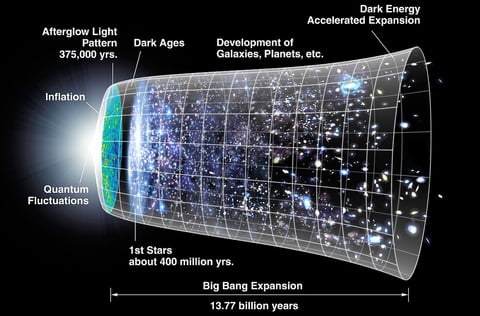
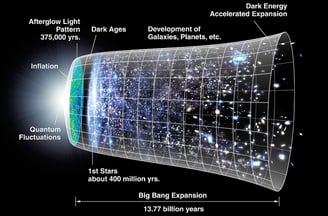
Timeline of the expansion of the universe (not to scale) (Image Credit: Wikipedia)
How Inflation amplified Quantum Fluctuations
A critical phase in this evolutionary narrative is cosmic inflation—a period of extremely rapid expansion that occurred within the first tiny fraction of a second after the Big Bang. Proposed in the early 1980s, inflation theory posits that the universe expanded exponentially, increasing in size by a colossal factor in an almost imperceptibly short duration. During inflation, quantum fluctuations were magnified to cosmic scales. The rapid stretching of space meant that these minute variations were imprinted onto the fabric of the universe, seeding the anisotropies observed in the Cosmic Microwave Background (CMB) radiation—the residual thermal radiation from the Big Bang. These anisotropies correspond to the slight temperature variations across the sky, reflecting the initial density fluctuations that would later evolve into galaxies and larger structures.


Illustration of quantum fluctuations in an inflationary universe (Image Credit: IAI TV)
The Transition from Quantum to Classical
One intriguing aspect of this process is the transition from quantum fluctuations, which are inherently probabilistic and microscopic, to classical density variations that have definitive, observable effects on cosmic scales. This transition is a subject of ongoing research and discussion in cosmology. Several theories attempt to explain this quantum-to-classical transition. One perspective suggests that as inflation stretched fluctuations beyond the observable horizon, they became "frozen" as classical perturbations. Another approach involves decoherence, a process where interactions with the environment cause a quantum system to lose its coherent superposition states, effectively behaving classically. Understanding this transition is crucial, as it bridges the gap between quantum mechanics and the classical physics governing large-scale structures.
A galaxy with physics equations in the foreground (Image Credit: Nautilus Magazine)
Observational evidence of The Cosmic Microwave Background
The most compelling evidence supporting the influence of quantum mechanics on the early universe comes from observations of the CMB. Satellite missions, such as the Cosmic Background Explorer (COBE), the Wilkinson Microwave Anisotropy Probe (WMAP), and the Planck spacecraft, have mapped the CMB with increasing precision. These observations reveal a pattern of temperature fluctuations that align remarkably well with predictions from inflationary models incorporating quantum fluctuations. The statistical properties of these temperature variations provide insights into the initial conditions of the universe. For instance, the slight non-uniformities in the CMB are consistent with a nearly scale-invariant spectrum of primordial fluctuations, a hallmark prediction of many inflationary models. These findings not only bolster the case for inflation but also underscore the profound impact of quantum phenomena on cosmic evolution.


The Cosmic Microwave Background Radiation as imaged by WMAP and Planck spacecraft. The temperature scale is represented below in microkelvins. (Credit: Astronomy Stack Exchange)
What are the implications and future directions?
The interplay between quantum mechanics and cosmology offers profound insights into the nature of reality. It suggests that the vast structures of the universe are, in a sense, magnified imprints of subatomic quantum events. This realization has profound implications for our understanding of the cosmos and the fundamental laws governing it. Future research aims to delve deeper into this connection. Upcoming missions and observations seek to detect primordial gravitational waves—ripples in spacetime generated during inflation. Such a discovery would provide direct evidence of inflation and offer further insights into the quantum processes at play during the universe's infancy. Moreover, advances in quantum simulations and high-energy physics experiments may shed light on the specific mechanisms driving inflation and the exact nature of the quantum fluctuations involved. As our observational and theoretical tools continue to improve, we move closer to unraveling the profound mysteries of our universe's origins.